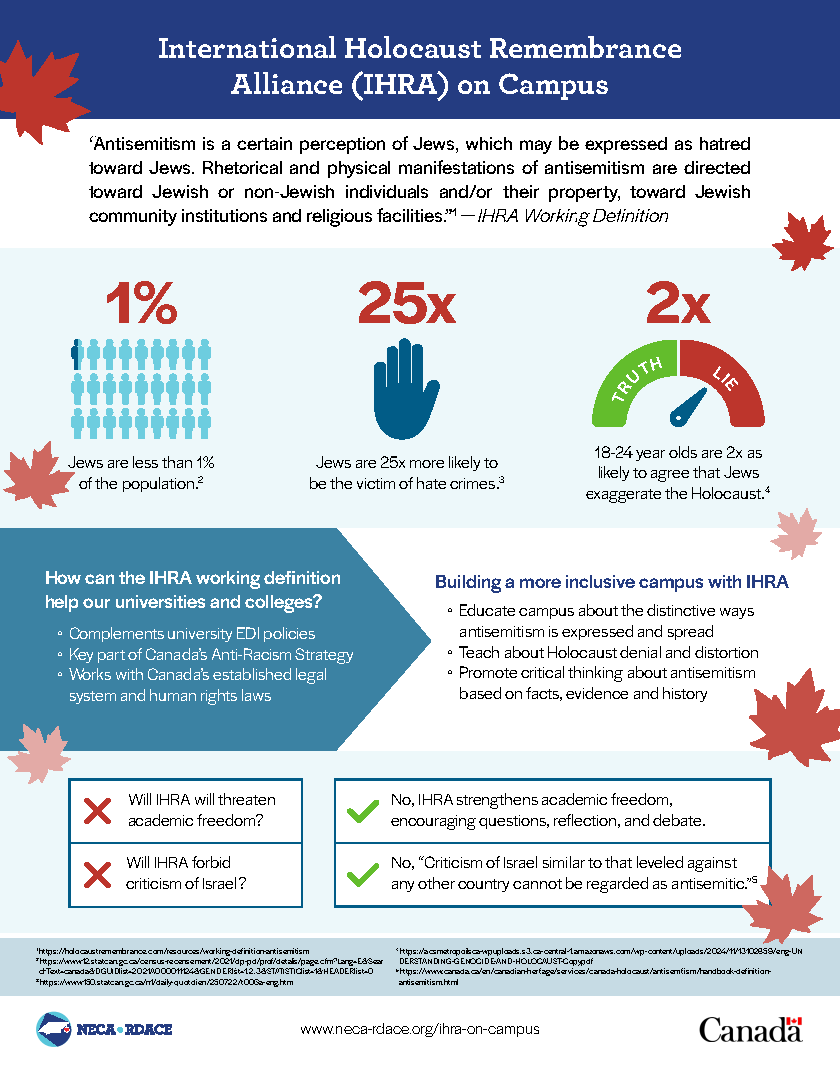
International Holocaust Remembrance Alliance (IHRA) on Campus
The IHRA definition of antisemitism was developed by an international group of scholars, lawyers, human rights experts and community leaders. It was a collaborative process that took years to complete and Canadian legal experts took leading roles. The International Holocaust Remembrance Association includes forty-three member nations and it continuously produces reports, educational materials, and resources designed to educate and assist individuals and organizations across that world to confront antisemitism. The IHRA definition is consistent with Canada’s established legal and human rights frameworks. But it is a working definition. This means it is intended to raise questions and provide a framework for understanding antisemitism but it includes no legal penalties and no policy directives. The IHRA definition can only help universities understand antisemitism, but it does not direct any institution on how to respond to antisemitism.
Why is IHRA controversial among some university faculty and faculty associations?
Some faculty insist that it will be used to erode academic freedom and that critics of Israel will be silenced. Some academics claim that actions of the Israeli state will no longer be examined in a critical way because the IHRA definition was created to silence Israel’s critics. Some have even suggested that any criticism of the state of Israel will result in dire professional consequences and that the IHRA definition is a serious threat to research.
What does IHRA say and what can it do?
The IHRA definition is not a speech code nor is it a set of rules that exclude ideas, questions or topics from discussion. It is a “legally non-binding working definition”. It offers tools, not prescriptive remedies. Moreover, the definition states, “criticism of Israel similar to that leveled against any other country cannot be regarded as antisemitic.”
It also advises that its examples “could, taking into account the overall context” be antisemitic. This makes clear that something could be antisemitic but context matters. The IHRA definition gives examples of common forms of antisemitism because antisemitism, like all forms of prejudice and discrimination, draws on tropes and familiar images to make its claims. Antisemitism may be present yet go unrecognized because it is so common and integrated into our social fabric.
Many critics of IHRA argue that this definition would give university administrators or outside groups the power to silence and punish opponents of Israel. But with careful examination of what IHRA states, we recognize it has no such force.
One of the classic texts of modern antisemitism is The Protocols of the Elders of Zion. It is a fabricated text produced in Russia in 1903 and it has been reproduced countless times since. It continues to be in wide circulation today, particularly on the internet. There is even a children’s book version. It describes a world where Jewish people covertly control governments, banks and social institutions to build Jewish power and control in the world. Historically, some religious beliefs taught that Jews were so evil they would stop at nothing to harm others. These lies shape perceptions about Jewish people and can be found across the political spectrum, in religious, and in secular antisemitic thinking. Such beliefs may underlie the fear that Jewish organizations will use IHRA to silence legitimate criticism of Israel because Jews possess excessive power and conceal their evil actions. Some critics of IHRA may not even recognize these antisemitic continuities. But it is not surprising that antisemitism would influence responses to a definition of antisemitism.
The IHRA definition cannot achieve what its critics fear because it is not a speech code nor is it a set of rules that exclude ideas, questions or topics from discussion. It is not legally binding, and it includes no prescription on remedies or procedures. IHRA is meant to be used as a tool to support education and processes. Under some conditions, it may well mean that some faculty and students are judged to have engaged in antisemitic activity just as they might be judged to have engaged in racist, misogynistic, or homophobic conduct. The consequences of such conduct are the responsibility of university administration and any applicable laws.
Each university determines how it manages speech, images, or actions that may be deemed antisemitic. That would be made in the context of broader regulations and the foundational principle of academic freedom. Canada has a well documented problem with antisemitism and universities can take the lead in addressing it.
How can IHRA be used in post-secondary educational institutions in Canada?
Antisemitism is soaring in Canada. Although Jews represent less than 1% of the population, they are the targets of 70% of all religiously motivated hate crimes and that number of cases rose 172% between 2020 and 2023 according to Statistics Canada. This means that Canadian campuses are experiencing a rise in antisemitism, alongside every other institution. The IHRA definition can help university administrations understand and address this problem.
A recent survey (https://www.claimscon.org/study-canada/) showed that 22% of Canadians of university age had not heard of the Holocaust and 23% believe the number of victims is exaggerated. These statistics demonstrate a serious gap in education. But it may also suggest that conspiracy theories about Jews exaggerating the Holocaust for their own benefit or lying to assert a false claim that they were victims of injustice are taking hold among Canadians. These conspiracies are widespread, particularly on social media. The Canadian Handbook on the IHRA Working Definition of Antisemitism includes several current, Canadian examples of social media posts that deny the Holocaust and claim that Jews are also lying about other things, including the October 7, 2023 attack on Israel. A precise understanding of antisemitism is essential to understand how these distortions work and how they work together to intensify false beliefs.
The IHRA definition’s examples remind us that denying or distorting the Holocaust is antisemitic. Universities can help diminish antisemitism by ensuring that Holocaust education is offered and that it explicitly counters the conspiracies and misinformation that many students will already have learned. Such education could be integrated into wider efforts to combat racism or to teach social media literacy so that students understand that this is not a distant history but part of a present crisis in misinformation and distortion. Students should understand how Holocaust denial and distortion contribute to antisemitism in Canada today.
The IHRA definition could shape university programming on racism and discrimination more broadly. Antisemitism has unique features that this definition describes. Jews are often depicted as powerful and influential and as the ones behind the scenes manipulating political events. Some theories of inequity argue that only groups recognized as powerless ought to be seen as victims of racism. University administrators responsible for creating and implementing policies about discrimination must understand antisemitism and the IHRA definition can help explicate its distinctive features.
Universities could compile data about how the IHRA definition has been employed in their policy decisions and in their management of antisemitic incidents. There is currently little data about the impact of the IHRA definition in Canada or in universities around the world that have adopted it. Well-designed research and data collection would be invaluable in shaping policy decisions going forward.