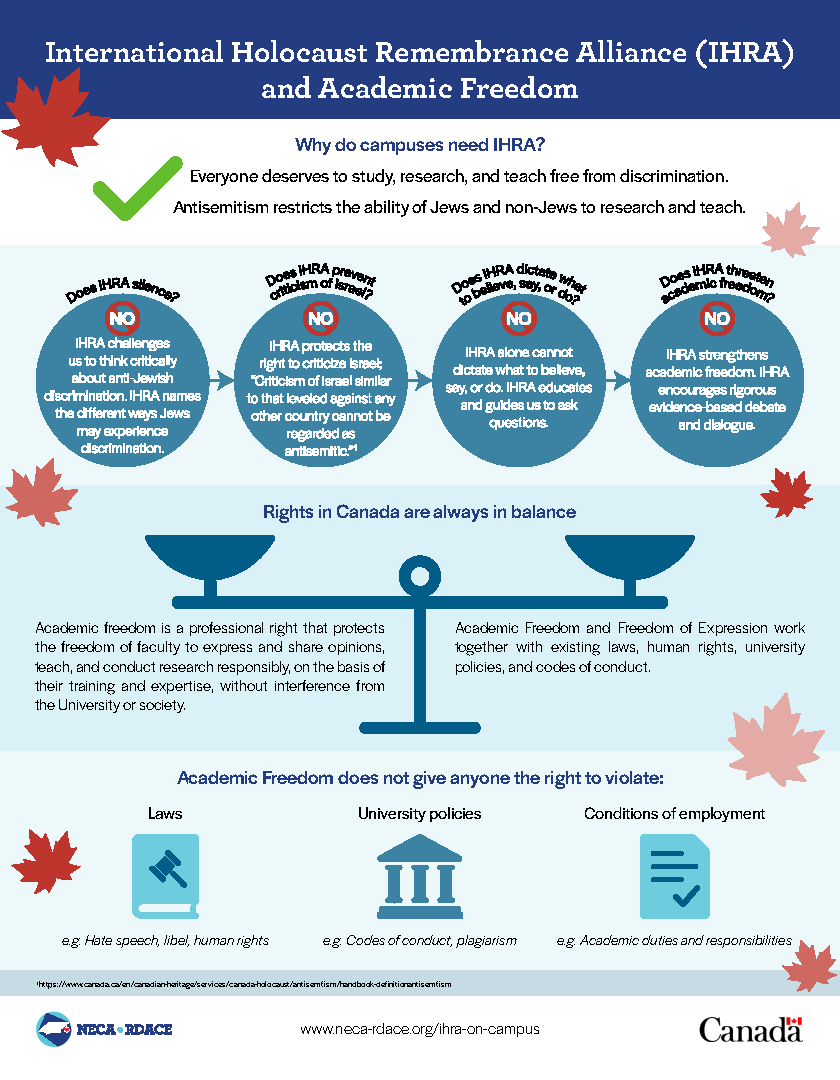
International Holocaust Remembrance Alliance (IHRA) and Academic Freedom
In Canada and other liberal democracies, academics working in institutions of higher learning play key roles in the dissemination of existing knowledge and discovery of new knowledge and innovations to advance society. Such pursuits can involve contending with complex and challenging ideas, interactions of people from diverse backgrounds and experiences, as well as interrogating differing viewpoints. Academic freedom is a right related to, but district from, freedom of expression that is granted to individual faculty members in recognition of the importance of protecting their work from the threat of censorship. Nonetheless, this right is not absolute and must be balanced with other rights and laws including those that protect students and faculty from harassment, discrimination, and a poisoned environment. This supplement shows how IHRA can be used to protect academic freedom and combat antisemitism.
What is freedom of expression? In Canada, freedom of expression is a fundamental right, guaranteed by the Canadian Charter of Rights and Freedoms. This right encompasses the freedom to express beliefs, opinions, and ideas, and to seek and obtain information. However, this freedom is not absolute and is subject to reasonable limits. These limits include: a) advocating genocide; b) publicly inciting hatred against an identifiable group where it is likely to lead to a breach of the peace; c) willfully promoting hatred against an identifiable group (except in private conversation); and 4) willfully promoting antisemitism by condoning, denying or downplaying the Holocaust (except in private conversation), and a limited group of other forms of expression that cause harm or infringe on the rights of others. The Canadian Charter of Rights and Freedoms applies to government agencies and does not automatically apply in the university context, but may apply in limited circumstances. Whether or not universities are legally considered to be governed by the Charter, they generally have policies and codes of conduct with a strong commitment to free expression. These protections apply to all members of the University community.
What is academic freedom? Academic freedom is a right related to freedom of expression but is distinct and in some ways more constrained because it is assigned to specific people serving a specific function in society. In Canada, there is no universally accepted definition of academic freedom and there are differing viewpoints about how to define it and its limits. In general, academic freedom is understood as a right afforded to individual faculty members, typically as a condition of employment enshrined in collective bargaining agreements or similar contracts with employers and thereby subject to labour law rather than constitutional law. Quebec’s Act Respecting Academic Freedom in the University Sector (2021) specifies that this right is afforded to “[a]ny person whose activities contribute to the university’s mission to produce and convey knowledge has the right to academic freedom.” Thus, academic freedom is generally understood to be a right of professors and not to other members of the university community including students. Academic freedom protects the autonomy of faculty members, but it is also a principle that protects the institutions in which they work from interference by outside groups (e.g. government, funding agencies, special interest). CAUT stated:
“[a]cademic freedom is not ... absolute any more than the freedom enjoyed by other citizens in a democracy is absolute. It must be exercised with responsibility and appropriate restraint.'' (CAUT, University Tenured Appointments and Their Purpose, Ottawa: CAUT, 1991)
Academic freedom allows faculty members to develop and share knowledge free from interference or bias. However, there is an expectation that professors exercising this right do so responsibly and within the scope of their expertise. Moreover, this right, which is a contractual agreement between the employer (university) and employee (professor) must be balanced with other rights and responsibilities to other parties (e.g., students, colleagues) as well as with prevailing laws. Professors have a duty of care to their students and must weigh their right to academic freedom with their obligations under human rights legislation not to engage in discrimination on protected grounds (e.g., race, gender, place of origin), which are often referenced in university codes of conduct and provincial human rights laws. In short, professors are expected to teach competently, create a respectful and inclusive classroom, and exercise their academic freedom responsibly by teaching and doing research based on accepted disciplinary principles. The exercise of academic freedom should also not constrain another individual who benefits from that same right. In balancing of rights and responsibilities, policies should not be instrumentalized to limit speech that is protected by academic freedom. In other words, limits to academic freedom should not be used to guard students or the public from being exposed to ideas that may challenge their beliefs and assumptions or cause discomfort. On the other hand, academic freedom should not be used as a shield against discrimination and hate or professional incompetence. Determining the optimal balance is challenging and complaints must be examined through a careful process that considers specific situational factors (e.g., whether speech was in the classroom, on social media platforms outside those sponsored by the university, as part of research) and include consideration of what is reasonable or responsible. Finally, academic freedom does not benefit society if it were to be used to stifle viewpoint diversity among faculty.
1. Is antisemitic speech protected by academic freedom?
Jewish people, like any other identifiable group on campus, have a right to receive an education free of harassment, hate speech, and discrimination. This right must be balanced with academic freedom. In some cases, it is clear that speech should not be protected by academic freedom. For example, it would be absurd to defend the academic freedom of a professor who denies or distorts the Holocaust. Other cases may be less obvious and require careful analysis.
The IHRA definition’s examples point to some of the tensions between legitimate criticism and discriminatory speech. In assessing these cases, a standard of reasonableness must be applied, including determining both its potential offensiveness and its contribution to a toxic work environment. This work would require both a clear understanding of antisemitism and academic freedom. Words or actions should be interpreted in light of how a student possessing the same personal characteristics targeted by the comments would reasonably be expected to respond. Moreover, it is not necessary to demonstrate that the professor intended the remarks to be harmful.
Choosing a style of presentation that demeans or marginalizes others is a matter of conduct, not an exercise of intellectual freedom. It is entirely possible to communicate ideas clearly and effectively while still demonstrating respect for the values and perspectives of others involved in the discussion. This respect is especially important when addressing a captive audience, such as students.
Furthermore, it would be disingenuous to ignore the power differential between student and professor or the fact that students are a captive audience in the classroom. After all, professors set the curriculum, assign readings and assignments, and control debate and discussion. Importantly, students’ grades depend on a fair evaluation of their work. Thus, the classroom is not a level playing field and expecting students to be able to express their dissent or file a complaint may be an unreasonable expectation. It may also be the first time a student is exposed to certain ideas and their ability to discern facts from opinion on a particular subject may be difficult. Academic integrity assumes that professors base their teaching on accepted standards of the discipline that is their expertise.
University officials may seek ways of addressing the problem without silencing the professor or ignoring the student’s complaint. They should balance academic freedom with other rights and responsibilities. These may include addressing academic malpractice with remedial support to address pedagogical deficiencies, requiring that additional material that offers a different valid perspective on the topic be included in the curriculum, providing students an opportunity to take the course with a different instructor, or providing students with alternative evaluation options.
2. Does IHRA stifle academic freedom?
Critics argue that IHRA will label speech and actions, particularly those related to the Israeli-Palestinian conflict, as antisemitic. IHRA is clear that criticism of Israel like that of any state cannot be considered antisemitic.
Suggesting that IHRA, in and of itself, is a restrictor of academic freedom is not justified by the facts. Determining whether speech is antisemitic and whether a member of the academic community’s rights have been violated does not rest solely on the IHRA Definition of Antisemitism. Rather, it is the people empowered to evaluate complaints who consider facts and context when determining the outcome of a complaint. IHRA is not a legal instrument and does not restrict freedom of expression or academic freedom. In fact, there are no examples in Canada where IHRA, and IHRA alone, has silenced scholars.
3. Boycott, Divest, and Sanction limits Academic Freedom
The Boycott, Divest, and Sanction (BDS) movement encourages academics, artists, businesses, and government officials to isolate Israelis and their supporters ostensibly to seek justice for Palestinians. From its onset, Omar Barghouti, co-founder of BDS, declared that his goal was to “euthanize” the Jewish state. Where terrorism and war had failed, he asserted that economic, cultural, and academic boycotts would prevail.
Since its inception, BDS has also been promoted in Canadian higher education primarily by faculty and student unions. Following the October 7, 2023 terror attack a new round of calls for BDS emerged.
BDS undermines cooperation and open dialogue on university and college campuses. Its proponents often argue that BDS does not interfere with academic freedom because it is only aimed at Israeli institutions and not individual academics. However, in practice, this is not true. Collaboration with international partners requires the support and coordination of institutions. BDS makes this impossible. Furthermore, BDS has become a gateway for a new type of antisemitism that is dividing students and faculty from one another and is inimical to actual peace, unity, or meaningful change in the Israel-Palestine conflict. The Canadian government recognized the discriminatory nature of BDS in February 2016 and passed a motion condemning the movement.
Boycotts that exclude individuals based on political views—such as barring academics due to Israeli citizenship or support for Israel—undermine academic freedom. Similarly, union motions advancing one-sided political positions may chill dissenting views. It would be equally improper to exclude faculty who support a Palestinian state or who actively pursue other political causes around the world. BDS is anathema to one of the key goals of faculty unions. If a faculty union takes a position on external political matters, it undermines its role in protecting academic freedom of all members. When it comes to matters outside the scope of the association’s mandate, members need not remain neutral, but the association must. This ensures that all viewpoints can be expressed and respected. It also ensures that the union can credibly defend academic freedom.