IHRA and EDI-D: Inclusive Campuses and Antisemitism
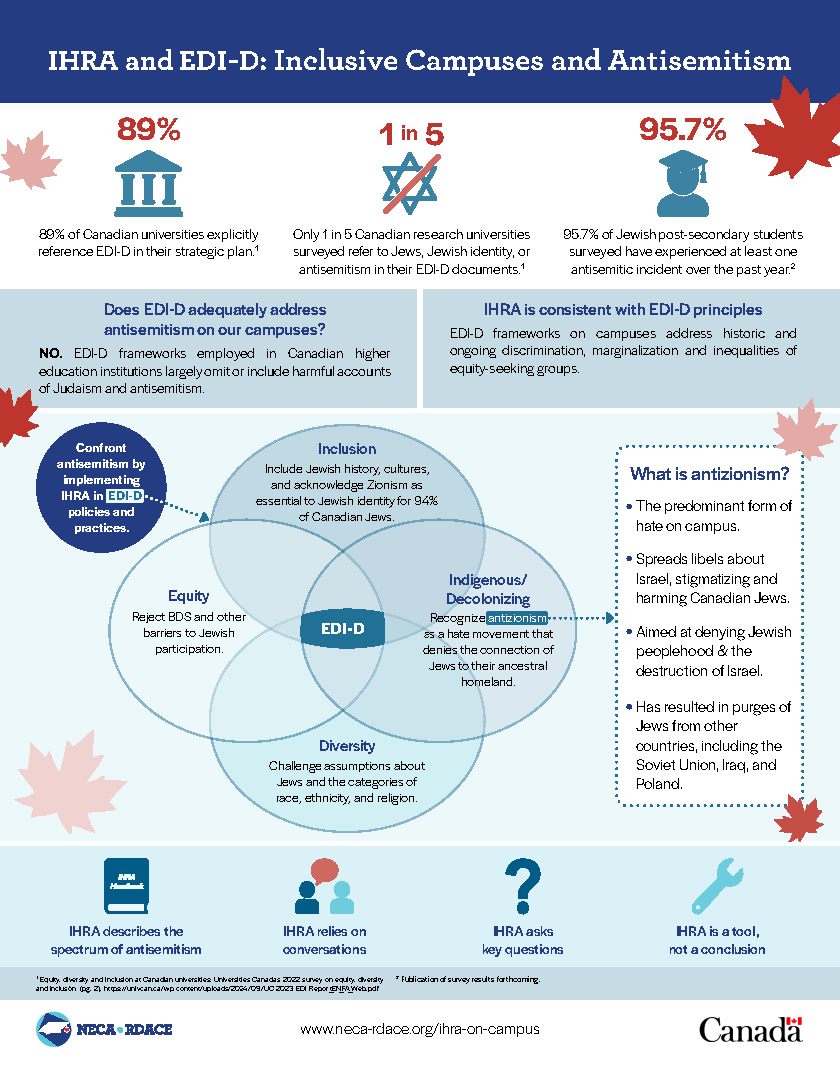
Canada strives to identify and remove barriers that prevent qualified people from diverse backgrounds from fully participating in society. Universities and colleges are places where learning and research must be able to flourish in an atmosphere of scholarly inquiry and robust debate, where all people can fully and meaningfully engage in campus life. University and college leadership are tasked with creating and sustaining inclusive campus environments for all students, staff and faculty. In Canadian institutions of higher education, this work has been accomplished primarily through equity, diversity, and inclusion (EDI) initiatives that seek to address historical exclusion and marginalization of equity-seeking groups. Emerging research has shown that the EDI frameworks employed in Canadian higher education institutions largely omit or include incomplete accounts of Judaism and antisemitism, and when they do, may do so in harmful and exclusionary ways. The following supplement discusses prevailing EDI frameworks and the ways in which these have been remiss with respect to Jewish identity, particularly, given the staggering increase in antisemitic hate crimes since October 7, 2023. It will also describe how IHRA can and should be incorporated in higher education EDI policies and codes of conduct.
How does EDI address issues of inclusion, equity and diversity?
Equity, diversity and inclusion (EDI) programs and policies have become the primary means by which Canadian higher education has chosen to address the ongoing effects of historical exclusion and marginalization of people belonging to equity-seeking groups. Equity refers to the aspiration for participants of all groups and backgrounds to achieve their potential and engage as full human beings in educational institutions. Diversity refers to acknowledging and respecting the range of different and intersecting personal, group, or community attributes (e.g., race, gender, ability, ethnicity, sexual orientation, religion, nationality). Inclusion refers to how diversity is leveraged to foster a culture of belonging by proactively inviting and enabling full contribution and participation.
Principles of EDI draw on existing legislation such as the Employment Equity Act, the Canadian Human Rights Act, and the Canadian Charter of Rights and Freedoms as well as provincial and territorial human rights laws. EDI policies and practices are often also informed by theoretical frameworks such as those grounded in anti-oppression, anti-racism, and social justice theories, that attempt to explain sources of inequities. EDI in Canada predominantly focuses on equity-seeking groups (defined in the Employment Equity Act as referring to women, Indigenous peoples, persons with disabilities, and members of visible minorities) who have been historically excluded in Canada. These important efforts have, however, limitations. Many other groups (e.g., 2SLGBTQ+, Jews) experience exclusion and marginalization. Moreover, a group may hold privilege in some contexts but be equity-seeking in another context. Finally, focusing on group membership may obscure important ways that individuals are excluded and marginalized. Rigorous scientific evaluation of the outcomes of the implementation of EDI programs in Canadian higher education, including benefits and risks, have not yet been conducted.
Jews do not fit easily into an EDI framework. They are well-represented in Canadian higher education, yet EDI frameworks often fail to appreciate the ways in which Jewish people are racialized and discriminated against. Jews are diverse and include people with roots in places like Ethiopia and Poland, people of wealth and poverty, and who embrace different traditions, but that complexity is not evident when EDI responds to antisemitism. EDI often also ignores the history of antisemitism in Canadian society, including for example, the impact of enrolment quotas for Jewish applicants to universities that persisted well into the 1960s. EDI frameworks often do not address antisemitism on Canadian campuses even with the shocking increase in antisemitic incidents. Recent statistics show that Jews are 25 times more likely to experience hate crimes as compared to the general population.
How does EDI (not) include Jewish identity and antisemitism in its frameworks?
Emerging research has shown that EDI frameworks employed in Canadian higher education institutions largely omit or include incomplete accounts of Judaism and antisemitism, and when they do, may do so in harmful and exclusionary ways.
First, when Judaism is referenced in EDI policies, it is almost always framed as merely a religion, yet Jewish identity can be secular, ethnic, or cultural. Ignoring the rich diversity of Jewish identity excludes many Jews from demographic surveys and narrows antisemitism to solely a form of religious-based hate. Second, many EDI programs cast Jewish people as “White” and “privileged” justifying their exclusion from EDI efforts that focus only on redressing the oppression of some groups. This exclusion emerges from misapplication of the anti-oppressive theoretical framework that has become oversimplified, dividing groups into oppressed and oppressors without consideration of context or the complexity of identity. Jewish people are often excluded from EDI by virtue of being seen as having overcome oppression as a “model minority” group. At best this frames Jews as beneficiaries of privilege and at worst falsely as perpetrators of oppression against other minoritized groups. This approach also treats Jews as a homogeneous group, yet there is substantial diversity among Jews including different ethnicities, skin colours, and levels of social and economic standing. Whereas approximately 10% of Canadian Jews are descended from immigrants from the Middle East and North Africa, over half of Israeli Jews have roots in the Middle East and Africa. Most importantly, modern racial categories were never intended to describe Jewish people. The racialization of Jews depends on a separate set of categories that have persisted and changed over hundreds of years. . The assumption that all Jews are “White” and benefit from “privilege” ignores Jewish history and is often the very language used to intensify hatred against Jews. For example, some EDI proponents assert that Jews embody Whiteness and privilege, a contemporary recapitulation of the old trope that Jews are powerful and controlling. When antisemitic tropes depicting Jews as powerful are combined with EDI discourses that seek to dismantle power and privilege, the result is a hostile environment for Jews coming from the very organizations that ought to address antisemitism.
When thinking about the inclusion of Jewish people in academic institutions, antisemitism must be understood as distinct from other forms of prejudice because of its flexibility and capaciousness, which enables seemingly contradictory tropes to coexist (e.g., Jews as capitalists and Jews as communists) . Antisemitism reinvents itself across time, recycling old tropes, while simultaneously creating new ones adapted to present day circumstances. Antisemitism can be understood as a set of lies, libels, or conspiracy theories that charge Jews, and more recently, the Jewish collective, the State of Israel, with serving as an obstacle to what is socially desirable for a particular era.
Expanded EDI: Decolonization in the Canadian context
EDI frameworks have been expanded as part of the Truth and Reconciliation process to include recognition of Canada’s history of settler-colonialism and mistreatment of Indigenous peoples. In higher education, this has been implemented through decolonization and indigenization efforts that challenge Western knowledge as neutral and universal and recognize the ways that Indigenous and non-Western knowledge systems may have been marginalized. Progress is being made in academia to address historic and ongoing wrongs toward Canada’s Indigenous people. In sharp contrast, Canadian Jews have had their historic, spiritual, emotional and in some cases, direct connection with Israel as their ancestral indigenous homeland denied and demonized. Whole courses, classes, invited lecturers, and union motions promote antizionist rhetoric that elides the fact that Israel is the birthplace of Jewish ethnic identity, language, culture, and religion, and Jews have maintained a constant presence there for over three millennia. Archeological evidence supports the assertion that Jews are indigenous to the land. There has also been a deep and ongoing cultural attachment among Jewish peoples toward Zion (referring to Jerusalem and the land of Israel) as expressed in liturgy and poetry, and this attachment is deeply interwoven within the range of secular and religious Jewish perspectives. Jews have a right to self-determination in their homeland just like other peoples, a fact that is historically and legally recognized as well as endorsed by 94% of Canadian Jews and the federal government of Canada. The co-opting and misapplication of settler-colonial discourses from the Indigenous experience in Canada to the Israeli-Palestinian conflict is inappropriate and discriminates against Jews. Many of the examples given in the IHRA definition relate to antizionism because it has become the predominant form of identity-based discrimination against Jews in contemporary society including, and especially, on Canadian campuses.
How can EDI be strengthened to include Jewish identity and dismantle antisemitism?
Respect for the dignity of all people must include dignity for Jews. A fundamental tenet of EDI is to ensure that those who experience exclusion and marginalization can articulate their experiences of discrimination. Campaigns to repudiate the IHRA definition, which have become increasingly common and normalized in academia, undermine that core principle. EDI can be strengthened and remain true to its intended goal of creating an inclusive campus environment by ensuring that Jewish identity and antisemitism are fully and appropriately integrated into EDI trainings, policies, and practices. EDI must challenge and debunk antisemitic tropes in higher education and efforts must be made to embrace positive Jewish representations, including education about the diversity of Jewish cultures, languages, and traditions. Antizionism, which applies a double standard to Jews by denying them their self-determination in part of the ancestral indigenous homeland, must be recognized as a form of identity-based hate and not be confounded with legitimate criticism of Israel. Antizionism is a hate movement and should not be confused with a political position against Zionism. Similar to earlier hate movements against Jews that cast them in opposition to all that is virtuous and desirable, antizionism casts the Jewish collective, Israel, as evil incarnate (e.g., inherently genocidal). In practice, antizionism does not concern itself with Jewish self-determination nor with challenging the connection of Jews with Israel. Rather, its goal is to demonize and delegitimize the Jewish collective. Antizionism has a long history that pre-dates the State of Israel and was used, for example, by the Soviet Union, to create a common enemy, thereby isolating and discriminating against its Jewish population. Wherever antizionism has thrived, Jews have been purged. Antizionism must be understood as a hate movement and treated as such by University administrators, EDI offices, and more generally within Canadian society.
The IHRA definition and the accompanying handbook provide readers with a flexible framework that in addition to informing its users about Jewish identity, the history of the Jewish experience in Canada, and the shameful history of antisemitism in Canada, is a useful tool to address specific incidents that may be antisemitic. The IHRA definition and IHRA Handbook are not prescriptive but rather supportive tools for those in higher education including leadership, policy makers, and decision makers. Implementing IHRA as a core part of EDI policies and practice will help to begin to address the worsening climate for Jewish people on Canadian campuses.